
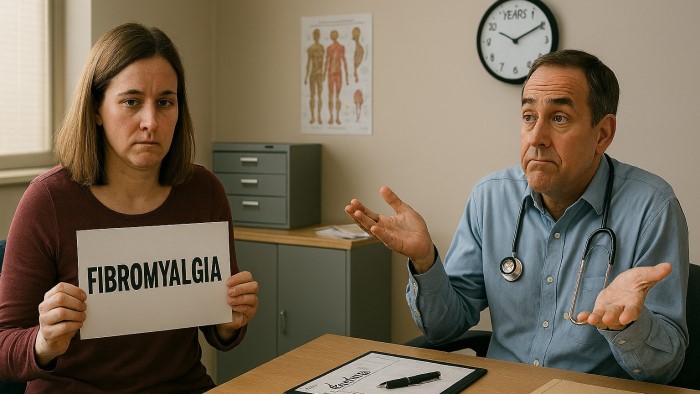
We need a national fibromyalgia care pathway – why is the NHS dragging its feet?
Share this post:
The National Health Service is failing people with fibromyalgia, with no clear system for diagnosing or treating the condition – despite revealing research.
The BBC has detailed the problems:
“People suffering from the chronic pain condition fibromyalgia are being failed by the NHS, according to new research which found patients were waiting years for diagnosis, undergoing unnecessary tests and being prescribed harmful drugs.
“Researchers at Aberdeen University said some doctors were even refusing to refer patients and dismissing them as “lazy”.
“Fibromyalgia causes pain all over the body and can bring on severe fatigue.
“Some estimates suggest one in 20 people may have the condition… There is no cure.
“It is not clear why some people develop fibromyalgia. The exact cause is unknown.
“Adele ended up paying to go private and finally got her diagnosis. She said: “The diagnosis was a relief but since then it’s been a case of there is no care pathway. You are told it’s definitely fibromyalgia you have – here are some pain killers.”
The way forward is already visible in the evidence – but, as ever with the UK’s health systems, what’s missing is the political will, clinical consistency and service design to act on it.
Please take a moment to complete the Vox Political Reader Survey.
Your answers are anonymous and will help shape future coverage.
Click here to take part.
Fibromyalgia has been stuck in a tragic holding pattern for decades: doctors don’t understand it, therefore they don’t diagnose it, therefore patients look “complex” or “non-compliant”, therefore doctors continue not to understand it.
This loop has harmed hundreds of thousands of people across the United Kingdom and placed enormous, unnecessary strain on carers – including me, in the 17 years I cared for someone with the condition.
But research cited in the BBC piece – yes, you need to go and read it – together with parallel work done over the last few years in pain science and primary-care modelling – points toward a route out of the mess. It’s not easy, but it is straightforward.
Here’s the practical, evidence-led path forward that the NHS could adopt now:
1. Standardised, early diagnosis as the default – not the exception
The Aberdeen team’s findings confirm what patients have said for decades: diagnosis is slow, inconsistent and heavily dependent on whether a clinician believes in the illness. That is untenable.
A national diagnostic protocol – mandated for all primary-care settings – would:
- end the “revolving door” of pointless tests
- stop patients being bounced between specialties
- give GPs confidence that they are following an accepted standard
The research already shows the criteria that work. There is no scientific justification for every clinician reinventing the wheel.
2. Replace the drug-first model with an evidence-based support-first model
MacFarlane’s team found patients overwhelmingly want personalised, non-drug support.
The literature backs that up: symptom-management education, pacing strategies, gentle progressive movement, sleep interventions and psychological support for coping all show greater long-term benefit than escalating painkillers.
The current system is backwards: patients are sent home with drugs that barely work and can cause harm, while the interventions that actually improve quality of life are either unavailable or left to charities.
A proper NHS fibro pathway would include:
- a short, structured education programme on the condition
- access to physio or occupational-therapy-led pacing and energy-management support
- brief psychological support (not to “fix” the illness, but to help cope with its unpredictability)
- diet, sleep and lifestyle guidance tailored to fibro’s known triggers
- peer support options (which have strong evidence for reducing isolation and improving self-management)
This is all cheap, scalable and already proven effective.
3. Multi-disciplinary fibro clinics – even virtual ones – to stop the ping-pong referrals
Patients are currently shunted between rheumatology, gastroenterology, neurology and pain services because nobody “owns” the condition.
The answer isn’t to expand referrals but to collate them: small teams with a rheumatologist or pain specialist, a physio, an OT and a psychology practitioner offering assessment and early-stage support.
This doesn’t require large new buildings; the evidence shows virtual clinics work very well for fibro because continuity, not geography, is what matters.
This change alone would save money: it stops duplicate tests, consultant time and unnecessary drug trials.
4. Mandatory education for clinicians
There is no future for fibro care while clinicians can simply choose not to believe in it.
Training based on pain neuroscience, central sensitisation research, and the lived experience of patients should be standard in GP training, physio training, and for consultant physicians in high-referral specialties.
Crucially, this must include challenging the outdated stigma – the “lazy”, “anxious”, “attention-seeking” stereotypes that MacFarlane’s study exposes.
These attitudes are not just unprofessional; they cause demonstrable clinical harm.
5. Carer involvement and support
My experience is typical: fibromyalgia affects whole households. Any real care pathway must formally include carers, with:
- education for carers about pacing, flare management, cognitive symptoms
- mental-health support and respite access (believe me – this is vital)
- involvement in care-planning conversations
At the moment, carers absorb the system’s failures for free. It is both inequitable and unsustainable.
6. Public-health recognition
Fibromyalgia is common – perhaps one in 20 people, as the BBC article notes – but is treated as if it is rare or marginal.
A national awareness campaign that normalises early help-seeking and reduces stigma would dramatically reduce diagnostic delay.
7. A policy shift: chronic pain as a cross-government priority
Fibromyalgia doesn’t just sit in health; it affects employment, social care, DWP assessments, public transport and mental health.
A joined-up chronic-pain strategy could:
- stop DWP assessors treating fibro as “psychosomatic”
- require employers to recognise fluctuating conditions
- integrate occupational-health support into fibro care plans
This is where political will matters most, because the failures are systemic.
What’s stopping progress?
The barrier is a mixture of:
- institutional scepticism rooted in outdated medical culture
- lack of ownership within the NHS (no specialty wants to “own” fibro)
- political reluctance to commit resources to conditions that don’t kill but do make life hell
Yet, as the Aberdeen study shows, the cost of doing nothing is higher: years of tests, inappropriate interventions, and the enormous personal cost to patients and carers.
So the answer is: a national fibromyalgia care pathway – fully funded, standardised, and designed with contributions from patients
It exists in fragments already. Scotland, Wales and some English regions have piloted versions. But what is needed is the UK-wide political decision that fibromyalgia is real, common, and deserves structured care, not dismissal.
That – combined with mandatory clinician education and a shift away from drug-first care – would end decades of neglect.
It wouldn’t cure fibromyalgia.
But it would stop the NHS worsening it.
Share this post:

I have been bounced from pillar to post over the years with my fibromyalgia,it’s always here take some pain killers or happy pills! I swear the naproxen I was put on a number of years ago contributed to the two strokes I have now had since 2017.
As for support there really is non out there…